


Your shopping cart is empty!
Tomato "Pokusa"
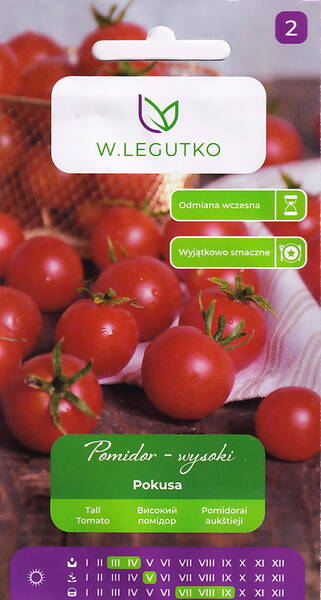
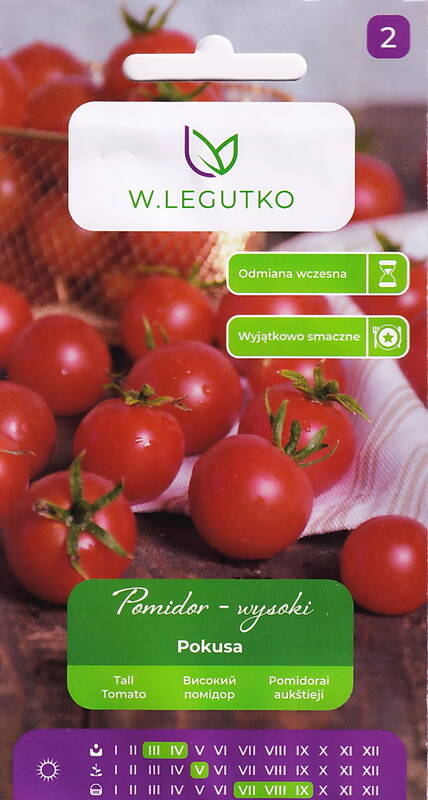
Tomato "Temptation" (Pokusa).
An early ripening variety with "cherry" type fruits. The plant is indeterminate, the stem is flexible and requires support.
Forms long clusters strewn with small red cherry-shaped fruits, weighing 10-20 g.
Recommended for fresh consumption and whole-fruit canning.
Agrotechnics.
Seeds are sown in cassettes or seedling boxes. At a temperature of +20+22°C, seedlings appear on days 5-7. When the 2nd pair of true leaves appears, the seedlings are picked, transplanting the plants into separate pots. You can plant seedlings in open ground, but you will need to cover them with both plastic film and spunbond.
During the growth period, seedlings must be regularly fed with mineral and organic fertilizers. When planting ready-made seedlings in the field, complex fertilizers and rotted manure are added to the hole. In mid-August, it is necessary to carry out decapitation (pinching off the top of the plant), which limits the growth of the plant and promotes the ripening of already formed fruits.
An early ripening variety with "cherry" type fruits. The plant is indeterminate, the stem is flexible and requires support.
Forms long clusters strewn with small red cherry-shaped fruits, weighing 10-20 g.
Recommended for fresh consumption and whole-fruit canning.
Agrotechnics.
Seeds are sown in cassettes or seedling boxes. At a temperature of +20+22°C, seedlings appear on days 5-7. When the 2nd pair of true leaves appears, the seedlings are picked, transplanting the plants into separate pots. You can plant seedlings in open ground, but you will need to cover them with both plastic film and spunbond.
During the growth period, seedlings must be regularly fed with mineral and organic fertilizers. When planting ready-made seedlings in the field, complex fertilizers and rotted manure are added to the hole. In mid-August, it is necessary to carry out decapitation (pinching off the top of the plant), which limits the growth of the plant and promotes the ripening of already formed fruits.
* Tomatoes in Open Ground: A Guide to Success.
Growing tomatoes in open ground is somewhat more challenging than growing cucumbers. Tomato plants are quite vulnerable to infections (late blight, streak, etc.), and any mistakes during the seedling stage irreparably weaken the bushes. Therefore, a multi-faceted approach is needed: finding the most suitable varieties, applying winning agrotechnical methods, and eliminating stress sources.
Alongside growing tomatoes in a greenhouse, you should definitely try growing some in open ground.
VARIETIES.
Choosing the right variety or hybrid is the first step. General requirements: it must be specifically designated for open ground.
Pay attention to taste qualities: look for the "excellent taste" label.
The maturation period should be minimal: varieties with a development cycle of up to 100-105 days are suitable (110 days is risky, and over 115 is hopeless for short summers).
Another important constraint is size. For open ground, it's better to choose varieties with a fruit weight of no more than 150 g.
For reliability, it's best to plant two groups: small-fruited (50-90 g) and medium-fruited (100-150 g). The smaller the fruits, the higher the chance they will fully ripen by mid-August. In a cold summer, only the small-fruited ones might turn red on the vine, while in a hot summer, both will succeed.
SEEDLINGS.
Seedlings require the utmost care. This is where most failures begin: not only will unhardened plants succumb to late blight during cold August nights, but their first flower clusters will also be weak.
For early-maturing varieties, two-month-old seedlings grown in dark apartment conditions are often so stretched and weak that a normal harvest is impossible. The first flower clusters are initiated when the third true leaf appears. Naturally, under poor spring lighting, very weak flower buds are formed. The goal is to force the plant to set new flower buds during a more favorable period — sunny May.
To achieve this, a radical technique can be applied around May 15: cut the stem above the 2nd true leaf to provoke the growth of two strong new shoots, and refresh the soil with generous hilling. The seedlings have 10-14 days to grow these shoots, resulting in sturdy, two-stemmed plants for transplanting.
When trying this for the first time, proceed cautiously and test it on only a portion of your seedlings.
PLANTING AND CARE.
Seedlings are planted in open ground in late May to early June. Plant in a single row with 30 cm between plants. A triangular-shaped raised bed is excellent for better soil warming.
Avoid areas where potatoes grew the previous year. Prefer spots where lime, ash, or plenty of compost was added (tomatoes dislike acidic soils).
Your main concern is keeping the soil weed-free.
Watering should be frequent but in small amounts. Tomatoes don't need excessive moisture, but letting the soil dry out completely can ruin the fruits. The optimal approach is 0.5 L per bush, followed by light mulching with dry soil.
In open ground, tomatoes can be grown with minimal feeding to prevent "fattening" (excessive foliage growth at the expense of fruits). Nitrogen fertilizers are acceptable only in June during stable sunny weather.
Beds with small-fruited varieties (cherry) require almost no pruning or side-shoot removal (suckering). They can even be allowed to sprawl, as their fruits rarely rot from touching the ground.
Conversely, medium-fruited varieties must be regularly pruned (suckered).
Until the main fruit mass stops growing, small side shoots can be tolerated (they maintain the plant's physiological activity), removing only those longer than 10 cm. However, when the first fruits start turning red (late July), a complete cleanup is necessary, removing all excess growth except for the ripening fruits and the leaves feeding them. This significantly improves soil warming and ventilation.
SAVING YOUR OWN SEEDS.
To solidify your success, save your own seeds.
First, plants grown from your own seeds gradually adapt better to your specific microclimate.
Second, you will have an abundant supply of seeds.
There is no need to fear cross-pollination, as tomatoes are self-pollinating.
Select the most beautiful and typical fruits from those that ripened mid-season. Let them fully ripen indoors. Squeeze the pulp and seeds into a bowl of water. Rinse the seeds, drain the water, and lay them out on paper to dry. After a couple of days, store them in paper envelopes.
Tomato seeds have excellent germination rates and longevity. Contrary to popular gardening myths, freshly harvested tomato seeds fruit perfectly well the very next year (excessive foliage is caused by too much nitrogen, not seed age). Seeds from one good harvest can be confidently used for 4-5 years.
NB! Seeds can only be saved from open-pollinated heirloom varieties; F1 hybrids will not breed true to type in the next generation.